
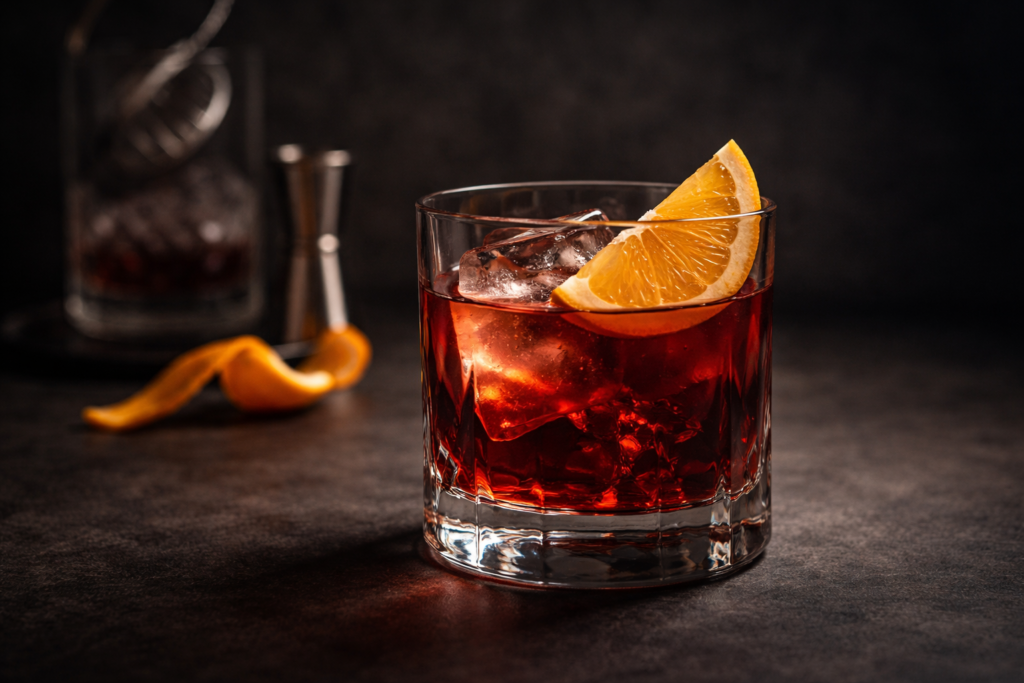
Most Negronis you’ve tasted were probably bad. Not offensively bad, just… forgettable. Built with vermouth that’s been open since last Christmas, stirred for about as long as it takes to lose interest, and poured over sad little ice cubes that turned the whole thing into bitter orange water before you even sat down. If that was your first impression, I don’t blame you for walking away. I blame whoever made it.
That’s tragic, because a properly made Negroni is one of the most satisfying things you can put in a glass. Three ingredients. Equal parts. And a stir. It’s the simplest cocktail to make and yet the line between “transcendent” and “why would anyone drink this” is embarrassingly easily crossed.
As a flavour professional, I spend my days deconstructing taste profiles, analysing how compounds interact, and understanding why things taste the way they do. This guide is the one I wish existed when I started obsessing over this drink: the recipe, the science behind it, the gin selection strategy, and a troubleshooting system so you never have to just shrug and add more of everything when something’s off. You’ll just know.
Table of Contents
What Is a Negroni?
A Negroni is an Italian cocktail made with three equal parts: gin, sweet vermouth, and Campari. Served over ice in a rocks glass, garnished with an orange slice. That’s the Wikipedia answer.
The real answer is that the Negroni is a balance exercise: three bold, opinionated ingredients that would happily ruin a drink on their own, held in tension by ratio and technique. Get it right and the cocktail transcends its parts. Get it wrong and you’ll understand why some people think it’s undrinkable.
It traces back to Florence in the early 1900s, but honestly the origin story has been told a thousand times and none of that will make your Negroni taste better. What matters is this: it’s deceptively simple to make and genuinely rewards precision. The kind of drink that tells you exactly how much you’ve been paying attention. The craft is understanding why each ingredient matters and knowing which lever to pull when something’s wrong.
The Classic Negroni Recipe
Ingredients
- 30 ml (1 oz) gin
- 30 ml (1 oz) sweet vermouth
- 30 ml (1 oz) Campari
- Orange slice for garnish
- One large ice cube for serving
Method
- Combine all three ingredients in a mixing glass.
- Add ice, fill the mixing glass about three-quarters full.
- Stir for 30 to 40 rotations. Smooth, steady, controlled. You’re chilling and diluting, not training for a cocktail competition.
- Strain over a single large ice cube in a chilled rocks glass.
- Garnish with an orange slice.
Why Stir, Never Shake
This comes up constantly, so let’s settle it. Shaking introduces air into the drink, creating a cloudy, frothy texture with tiny ice shards. That’s perfect for cocktails with citrus juice or egg white, drinks that benefit from aeration and a lighter mouthfeel.
The Negroni is none of those things. It’s spirit-forward, built entirely from booze. You want clarity, viscosity, and silk. Stirring gives you clean, controlled dilution without disrupting the drink’s density. The result is a Negroni that looks jewel-like in the glass and feels rich on the palate.
Shake a Negroni and you’ll get something thin, foamy, and visually murky. It’ll taste fine. It won’t taste right. And if you do it in front of someone who knows, they will remember.
The Science of the 1:1:1 Ratio
Equal parts is where every Negroni starts, but understanding why it works is what separates someone who follows a recipe from someone who can actually build a drink.
Here’s what each component brings to the balance:
Gin provides the structural backbone: juniper, botanicals, and alcohol strength. It’s the skeleton of the drink. Without enough gin, the Negroni collapses into a sweet-bitter syrup. Too much, and it becomes flavoured gin on the rocks.
Sweet vermouth delivers sweetness, herbal complexity, and body. It rounds out the bitterness of Campari and softens the sharpness of the gin. Think of it as the diplomat, the ingredient that makes the other two behave.
Campari is the non-negotiable. Bitterness, yes, but also a distinctive sweetness of its own, along with that unmistakable red-orange colour. Campari is what makes a Negroni a Negroni. Remove it and you have a completely different drink. And probably a worse one.
At 1:1:1, the sweetness from vermouth and Campari counterbalances the bitterness, while gin provides just enough structure to prevent the drink from tipping into sickeningly sweet territory. It works. Beautifully.
The dilution variable is the part most people forget entirely. Stirring adds roughly 15–20% water content to the drink, and that water is part of the recipe. Under-stir and the drink is aggressive, harsh, and overly concentrated, though if you like your drinks with a bit more bite, you might enjoy it that way. Over-stir and it goes flat and lifeless. The sweet spot is 30 to 40 rotations with fresh, cold ice, enough to chill to around -3°C to -5°C.
When to Break the Ratio
The 1:1:1 ratio is a starting point, not a commandment. Here’s when to adjust:
Your gin is assertive.
Navy strength, barrel-aged, or a very juniper-forward London Dry. Try 1.25:1:1 or even 1.5:1:1 (gin : vermouth : Campari). The extra gin can stand up to the other two without getting buried.
Your vermouth is very rich.
Carpano Antica Formula, for instance, is noticeably sweeter and heavier than Martini Rosso or Dolin Rouge. If the drink tastes too sweet, pull the vermouth back to 0.75 parts before touching anything else.
It’s too bitter for your palate.
Increase vermouth, not gin. The vermouth’s sweetness directly counteracts Campari’s bitterness. Adding more gin just makes the drink stronger without fixing the problem. More booze is rarely the answer. Except when it is.
It’s too sweet.
Increase gin slightly, or switch to a drier vermouth. You can also reduce the vermouth by a few millilitres rather than swapping bottles entirely.
The key is learning which lever to pull when something tastes off. The ratio, the dilution, and the specific bottles you use are all variables. Identify the problem, adjust one variable at a time, taste again. If you’ve already made the drink and something’s off, the troubleshooting section below will help you fix it in the glass!
Once you have the framework down, once you understand why the drink works, a whole new world opens up. Playing with variants, incorporating infused ingredients, swapping gin styles, adding a dash of aromatic bitters, changing your garnish to complement a specific gin or infusion, adjusting dilution for different occasions. That’s where the Negroni stops being a recipe and starts being yours.
Choosing Your Gin
The gin you use fundamentally shapes the character of your Negroni. Not all gins behave the same way against Campari and vermouth, and understanding the three main categories will let you build the exact Negroni you want.
London Dry: The Classic Foundation
London Dry is the traditional style: juniper-led, dry, and defined by a straightforward botanical profile. It provides a clean, recognisable backbone that lets Campari and vermouth share the stage equally.
Best for:
Your first Negroni. The purist approach. Understanding what the classic should taste like before you start experimenting.
Recommended bottles:
Tanqueray (a solid entry-level choice, sharp, clean, reliable),
Sipsmith (a bit more botanical complexity while staying in the London Dry lane),
Never Never Triple Juniper (Australian, bold, and proof that London Dry doesn’t have to be boring).
I’ll be honest, I’m not a huge London Dry person. The juniper-forward profile, while classic, tends to trade complexity and depth for a straightforward juniper punch in the face, so to speak. And the most common London Drys (Gordon’s, Beefeater, Bombay) aren’t cheap so much as uninspiring. They’ll make a decent Negroni. But “decent” isn’t really what we’re going for here, is it?
Modern / Contemporary Gin: Where It Starts Getting Fun
Less juniper, more citrus, florals, and exotic botanicals, depending on the bottle. Modern gins push the Negroni in a more aromatic territory. The cocktail can feel lighter, more fragrant, and more complex. This is where the drink starts revealing layers that a London Dry simply can’t deliver.
Best for:
Starting to experiment with more aromatic complexity. A modern gin brings depth and personality that makes each Negroni truly different depending on the bottle you reach for.
Recommended bottles:
Monkey 47 (my all-time favourite gin, period. German, complex, herbal, 47 botanicals, and it makes a Negroni that’s almost unfairly good),
The Botanist (Islay-sourced, 22 foraged botanicals, structured like a London Dry but bolder, stronger and more complex),
Four Pillars Rare Dry (Australian, orange-forward, punches through Campari beautifully).
One caution:
Very delicate gins will get completely buried by Campari. Bottles like Malfy Rosa, Bloom, or anything that leans heavily on soft florals without backbone will simply vanish in the mix. You’ll spend €40 on a bottle of handcrafted botanical poetry and taste absolutely none of it. Campari doesn’t care about your gin’s feelings.
Barrel-Aged Gin: The Game-Changer
This is where things get really interesting. Barrel-aged gin spends time in oak casks, usually ex-bourbon, ex-wine, or ex-sherry barrels, picking up vanilla, caramel, and warm spice. But more importantly, the ageing process rounds out the gin’s sharp edges, making it smoother and silkier. The result has a golden colour that transforms the Negroni’s appearance and flavour profile entirely.
Best for:
Telling the world you’re not an amateur anymore. This is next-level Negroni territory. If you love Boulevardiers (the bourbon-based cousin of the Negroni), barrel-aged gin gives you that same warmth and depth while keeping the Negroni’s botanical DNA intact.
In the drink: The oak notes round out Campari’s bitterness in a way that no amount of stirring can replicate. The vanilla from the barrel bridges the gap between gin and vermouth, creating a more cohesive, warmer, silkier drink. The colour shifts from bright red-orange to a deeper amber-rust.
Recommended bottles:
Dancing Sands Barrel Aged (New Zealand, aged in French oak and ex-rum barrels. My current favourite for Negronis, beautifully balanced oak influence),
Harahorn Cask Aged (Norwegian, 12+ months in Oloroso sherry casks, rich and rounded, excellent in a Negroni),
G’Vine Nouaison Réserve (French, aged in ex-cognac casks. Stunning but expensive, and honestly almost too good to mix. Almost).
One to avoid:
Peddlers Barrel Aged. Shanghai-made and interesting on its own, but the heavy cinnamon notes dominate the drink. In a Negroni, it doesn’t complement, it hijacks. All you’ll taste is cinnamon screaming over everything else.
Every Negroni I make now uses barrel-aged gin. I’d say “once you try it, it’s hard to go back,” but that undersells it. You won’t want to go back. You’ll wonder what you were doing before and at some point, you’ll stop buying barrel-aged gins and start ageing them yourself. Just because you can.
Choosing Your Vermouth
If there’s one thing that ruins more Negronis than anything else, it’s bad vermouth. Not “cheap” vermouth. Dead vermouth. If that bottle has been open for more than two-three months, do yourself a favour and pour it down the sink. Your Negroni will thank you.
The rule is simple: refrigerate after opening and use it within four to six weeks. Treat it like wine, because that’s what it is. Fortified wine with a shelf life that people love to ignore.
Sweet (rosso) vermouth is the only appropriate choice for a Negroni. If someone tells you to use dry vermouth or Bianco, smile politely and change the subject.
Martini Rosso should be in every Negroni starter kit. It’s available practically everywhere, pairs easily with any gin, and makes a reliably good Negroni. If you’re starting out or just want something consistent, this is your bottle. It’s not going to change your life, but it won’t embarrass you either.
Cocchi di Torino is where I’d point you next. Bittersweet, balanced, herbal, and complex without being overpowering. If you want one upgrade from Martini Rosso, this is it.
Carpano Antica Formula is the rich, intense option. Vanilla, dark fruit, and a full body that makes Negronis feel luxurious. It’s also sweet enough that you may want to pull the ratio to 1:0.75:1. The kind of bottle that makes you feel like you know what you’re doing, but it demands you adjust around it.
Dolin Rouge is lighter, drier, and more restrained. If you find your Negronis too sweet with the others, Dolin will dial it back without losing the herbal character.
For those who want to push further: vermouth infusions can take your Negroni somewhere entirely personal. That’s an advanced move and deserves its own dedicated guide.
The Campari Question
Campari is the soul of the Negroni. We called it the non-negotiable earlier. This is why. It’s the only ingredient in a Negroni that has no real substitute. The bitter, sweet, citrus-peel character of Campari is what defines this cocktail and what makes it polarising. Most people who think they don’t like Negronis have never actually had a proper one. They’ve just had a poorly made drink with Campari in it.
On alternatives:
They exist, in theory. Aperol, Contratto Bitter, Select Aperitivo, and various craft bitter liqueurs can technically stand in for Campari. But they change the drink fundamentally.
Aperol makes it softer, sweeter, and turns it into something your drink didn’t ask to be. That’s not a Negroni. That’s a surrender.
Contratto is closer but much lighter.
Select Aperitivo is popular in Venice and great in a Spritz, but it’s not Campari.
If you want to customise without losing the bitter core, Campari infusions are the move. Infusing Campari with additional fruits, spices, or botanicals gives you a personalised bitter element that’s still unmistakably Campari-based. This is where you stop following recipes and start signing your work.
Ice, Dilution & Glassware
These feel like small details. They’re not. They’re the difference between a Negroni that stays cold and structured for twenty minutes and one that falls apart in five.
Ice: Use a single large cube or sphere. The physics are straightforward: a large cube has less surface area relative to its volume than the same amount of ice broken into smaller pieces. Less surface area means slower melting, which means your drink dilutes more gradually. Standard ice cubes from a freezer tray will turn your Negroni into a watered-down memory before you’re halfway through it. At that point, you might as well drink water. At least commit to something.
Glassware: A heavy-bottomed rocks glass. Thick walls insulate the drink, keeping it colder for longer and slowing ice melt further. Thin, delicate glasses look lovely but transfer heat from your hand to the drink faster than you’d like. Chill the glass in the freezer for 15 to 20 minutes before serving. It makes a noticeable difference, and it costs you nothing.
The dilution window: A properly stirred Negroni served over a large cube in a chilled glass gives you a roughly 15 to 20 minute window where the drink is at its best. After that, the ice wins and the balance shifts toward flat and watery. This is the drink’s natural lifecycle. Don’t fight it, just drink at a steady pace.
For those who like it stronger: Stir without ice, then pour the room-temperature mix slowly over a single large cube in a chilled glass. The cube cools the drink down quickly without the dilution you’d get from stirring over ice. You start with the Negroni at full strength, and then it evolves in the glass as the cube slowly melts. A completely different experience.
The Garnish: Why It Matters
The classic garnish is an orange slice. It’s what you’ll see in most bars across the world, and it’s what I use. If you’re skipping the garnish, you’re skipping part of the drink. You wouldn’t leave out one of the three ingredients, so don’t leave out this either.
Before dropping the slice in, give it a very slight squeeze over the glass. The few drops of juice and the burst of citrus oil from the peel bring a brightness that lifts the entire cocktail and softens Campari’s bitterness just enough. It’s a small gesture that makes a real difference. Skip it and your Negroni will taste fine. Do it and you’ll wonder why you ever didn’t.
Some bartenders prefer a peel instead, expressed over the drink for a more concentrated burst of citrus oil without adding any juice. That works too. The peel gives you a sharper aromatic hit. But there’s something about a bright orange slice sitting in that deep red drink that just looks right. Call it aesthetics. I call it non-negotiable.
On lemon: No. God, no. Not for a classic Negroni. Lemon changes the aromatic profile entirely and pulls the drink in a direction it wasn’t designed to go. If someone serves you a Negroni with a lemon garnish, you now have permission to judge them.
On aromatic bitters: Yes. Absolutely yes. This is one of the most underrated ways to personalise a Negroni. A few drops of aromatic bitters on top can subtly shift the direction of the drink. And I don’t just mean Angostura. Fruit bitters, chocolate bitters, chilli bitters, floral bitters. The options are endless. My recommendation: make the drink first, taste it without bitters, then add one or two dashes, smell and taste again. The difference will surprise you.
As you get deeper into the Negroni rabbit hole, you’ll find that garnish choices and bitters become part of the creative process. Different gins and different infusions call for different accompaniments. A grapefruit twist with a Monkey 47 Negroni, for instance, brings the drink to a whole new dimension. A square of dark chocolate with a dash of lavender bitters alongside a barrel-aged Negroni is an experience worth having. But that’s for later.
Variations Worth Knowing
The Negroni’s three-part structure is one of the most remixable frameworks in cocktails. Swap one ingredient and you get a family of related drinks, each with its own character. Here are the ones worth your time.
Negroni Sbagliato
Replace gin with dry sparkling wine (traditionally Prosecco). Lighter, fizzy, and significantly lower in alcohol. The name means “mistaken Negroni,” and it went viral a few years back. Good for warm weather or when you want a Negroni’s flavour profile without the strength. It’s also a useful tell: if someone prefers the Sbagliato, they might not be ready for the real thing yet.
Boulevardier
Replace gin with bourbon or rye whiskey. This shifts the drink from bright and botanical to dark, warm, and spiced. The whiskey’s caramel and vanilla notes interact with Campari differently than gin does, creating something richer and more autumnal. If you enjoy barrel-aged gin Negronis, the Boulevardier is its spiritual cousin.
White Negroni
Replace Campari with Suze (a French gentian liqueur) and sweet vermouth with Lillet Blanc. This is almost a completely different drink: pale gold, floral, bitter in a vegetal rather than fruity way. Worth trying, but don’t expect it to taste like a Negroni. It shares the architecture, not the flavour.
Mezcal Negroni
Replace gin with mezcal. Smoky, bold, and divisive. The smoke either thrills or overwhelms. There’s no middle ground. Try it with a joven mezcal (unaged) to keep some brightness, and prepare for strong opinions from anyone you serve it to.
Batching Negronis for Groups
The Negroni is the easiest cocktail to batch. Equal parts of everything, no citrus to squeeze, no egg whites to deal with. It’s almost suspiciously simple. If you’re hosting and don’t want to spend the evening playing bartender, this is the drink to pre-make.
The ratio stays the same. Equal parts gin, vermouth, and Campari. For a group of six, that’s roughly 180 ml of each (six servings at 30 ml per ingredient per drink). Pre-mix everything in a bottle or jar. You’ll look effortless. That’s the point.
Fridge method: Add approximately 20% water to the pre-mix (roughly 110 ml for the batch above) to simulate the dilution you’d get from stirring. Refrigerate for at least four hours. Overnight is better. Pour directly over a large ice cube in each glass.
Freezer method: Add approximately 15% water, seal tightly, and store in the freezer. The alcohol content prevents it from freezing solid. Pull it out, pour over ice, garnish, and serve. Your guests will think you’re a genius. Let them.
Shelf life: One to two weeks refrigerated. The vermouth is the perishable element. It will start to turn after that. If you want longer storage, batch without the vermouth and add it fresh when serving.
Troubleshooting: When Your Negroni Is Off
This is the framework that turns guesswork into precision. If your Negroni doesn’t taste right, don’t panic and don’t pour it down the drain just yet. Most problems can be fixed in the glass. Diagnose what’s off, adjust, and taste again.
Too bitter. The most common complaint. Usually caused by under-dilution (you didn’t stir long enough) or a gin that’s too neutral and isn’t pushing back against the Campari. Already in the glass? Add a small splash of vermouth to bring the sweetness up. For next time, stir longer or switch to a richer vermouth like Carpano Antica. Do not reduce Campari. That changes the fundamental character of the drink.
Too sweet. Your vermouth is dominating. This happens with very rich vermouths like Carpano Antica or if you’ve over-poured. Already in the glass? Add a few drops of gin to push back. For next time, reduce vermouth to 25 ml (0.75 parts) or switch to Dolin Rouge, which is drier and more restrained.
Too boozy or hot. Under-diluted. The drink needs more water. Already poured? Let it sit on the ice a little longer and let dilution do its work. For next time, stir for an additional 10 to 15 rotations and make sure your ice is as cold as possible.
Flat or watery. Two possible causes. Either you over-stirred, or your vermouth has gone off. This one is harder to rescue in the glass. Check the vermouth first. If it smells dull or slightly vinegary, that’s your answer. Replace it. If the vermouth is fresh, add a small splash of each ingredient to bring the drink back to life. Stir less next time and use a larger ice cube for serving.
No aroma. You skipped the garnish, or you didn’t use fresh citrus. Easiest fix of all: grab an orange slice, give it a slight squeeze over the drink. Instant improvement. Always garnish. It’s not optional, it’s functional.
Muddy or unstructured. The gin is too subtle for the job. Delicate, floral gins can get completely buried by Campari and vermouth, leaving a drink that tastes like sweet bitterness without a backbone. Can’t fix this one in the glass, unfortunately. Switch to a more assertive gin next time. The gin needs to punch through.
Frequently Asked Questions
What is the ratio for a Negroni? The classic ratio is 1:1:1, equal parts gin, sweet vermouth, and Campari. In metric, that’s 30 ml of each. This is the starting point. Adjust based on your gin, vermouth, and palate.
Is a Negroni shaken or stirred? Stirred. Always. Shaking introduces air and creates a frothy, cloudy drink. The Negroni is spirit-forward and benefits from the clean, silky dilution that stirring provides.
What gin is best for a Negroni? London Dry (Tanqueray, Sipsmith) is the classic choice. For more depth, barrel-aged gin transforms the drink entirely. My personal favourite is Monkey 47 for a contemporary approach, and Dancing Sands Barrel Aged when I want something richer.
Can you make a Negroni without Campari? You can substitute other bitter liqueurs, but the result is a different drink. Campari is the non-negotiable. Without it, you’re in variation territory, not Negroni territory.
How do you make a Negroni less bitter? Increase the vermouth slightly, from 30 ml to 35 ml. The vermouth’s sweetness directly counteracts Campari’s bitterness. Also stir longer, as additional dilution softens the bitter edge.
What glass do you serve a Negroni in? A heavy-bottomed rocks glass with a single large ice cube. Chill the glass beforehand. It’s a small step that makes a real difference.