
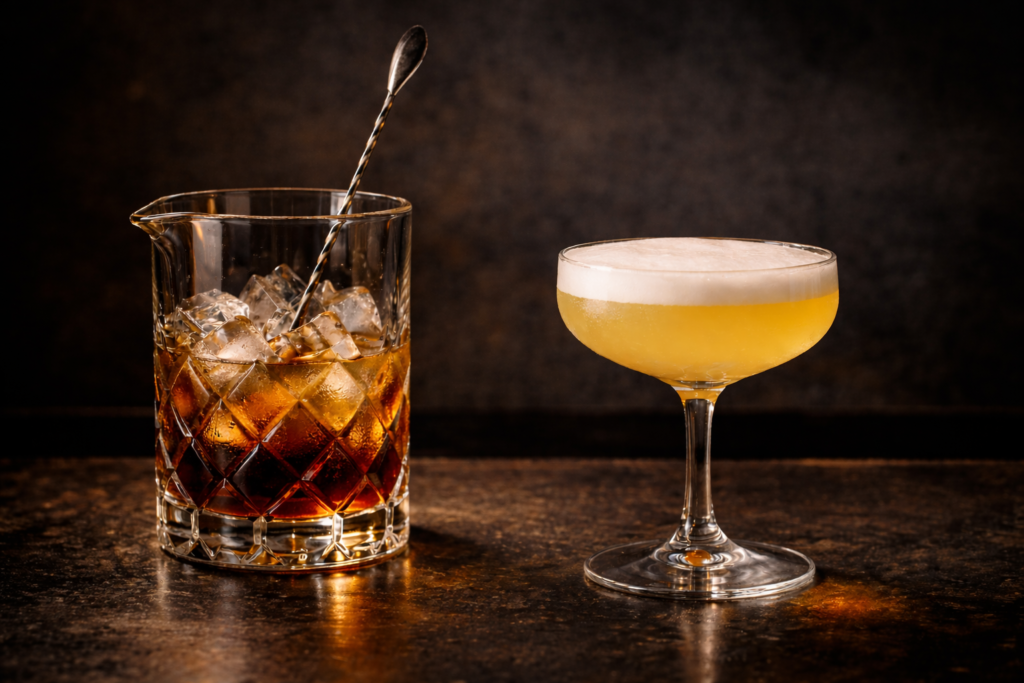
Ever made a cocktail at home and wondered why it didn’t look or taste like the one you had at the bar? The Whisky Sour with no foam. The Margarita that tasted like lime juice poured over tequila. The Negroni that came out cloudy and foamy when it should have been clear and silky.
Chances are, you shook something that should have been stirred. Or stirred something that should have been shaken.
Everyone knows the rule. If there’s citrus, shake. If it’s all spirits, stir. It’s clean and simple.
Except that it’s incomplete.
It tells you what to do but never explains why. Which means the moment you encounter a drink that doesn’t fit neatly into either category, you’re guessing. And guessing is how you end up with a White Russian smoothie or an Espresso Martini so flat and lifeless you’d start second guessing your life choices.
Here’s what nobody tells you: shaking and stirring aren’t mixing methods. They’re flavour decisions. Each one changes the texture, temperature, aroma delivery, and balance of a drink in ways you can actually measure. Choose right and everything simply clicks. Choose wrong and the drink will fall apart in the glass.
As a flavour professional, I think about this differently than most bartending guides will present it. I don’t care about tradition. I care about what’s happening inside the glass at a physical and molecular level. Once you understand that, every cocktail you make from this point forward will thank you for it.
By the end of this guide, you won’t need the rule anymore. You’ll just know. And you’ll be the only person in the room who can properly debate Bond’s Vesper Martini.
Table of Contents
The Shake: Science, Application, Technique
The Science
Most explanations stop at “it mixes things.” That’s like saying baking is “cooking things.” Shaking has five distinct effects on a cocktail, and each one matters.
It chills. And it chills fast. Shaking reaches around -5°C to -7°C in about 10 to 15 seconds. The violent contact between ice and liquid transfers heat far more efficiently than gentle stirring. If you’re serving a drink up with no ice in the glass, you need it as cold as physically possible before it leaves the shaker, because from that point on it’s only getting warmer.
It dilutes aggressively. A shaken drink picks up roughly 25 to 30% water by volume in those 15 seconds. The ice fractures on impact, exposing more surface area, which accelerates melting. This sounds like a problem until you realise that drinks designed to be shaken need that water. A Daiquiri without proper dilution is just rum and lime fighting each other.
It aerates. Tiny air bubbles get trapped in the liquid, changing the mouthfeel from dense to light, almost effervescent. The drink feels physically different on your tongue. Remember that flat, lifeless Espresso Martini from the intro? That’s what happens when aeration fails. The crema on top of a properly shaken one comes from coffee oils being emulsified by the force of the shake. It isn’t decoration. It’s the whole point.
It emulsifies. Citrus juice, egg whites, cream: these don’t blend with spirits willingly. Shaking forces them into a temporary emulsion, a unified liquid that holds together long enough for you to drink it. This is why a Whisky Sour gets that signature velvet foam and why a Margarita feels bright and integrated rather than layered and disjointed. Stir an egg white into bourbon and watch what happens. Spoiler alert: nothing good.
It integrates flavour. A shaken drink tastes like one thing, not four things layered on top of each other. The individual ingredients merge into something new. You’re not sipping tequila, then lime, then orange liqueur. You’re sipping a Margarita. That unity is the goal.
The Application
Shake when the drink needs ingredients forced together that wouldn’t blend on their own. When it needs a lighter, refreshing texture. When it needs maximum chill in minimum time. When the goal is a unified flavour where individual components disappear for the greater good.
In practice, that means any cocktail containing citrus juice, egg whites, cream, dairy, or thick syrups.
Classic cocktails that need a good shake:
- Daiquiri — rum, lime, sugar
- Margarita — tequila, lime, orange liqueur
- Whisky Sour — whiskey, lemon, sugar, egg white
- Espresso Martini — vodka, coffee liqueur, espresso
- Cosmopolitan — vodka, cranberry, lime, Cointreau
- Gimlet — gin, lime, sugar
- Bee’s Knees — gin, lemon, honey syrup
If the recipe includes something that doesn’t naturally mix with spirits, the shaker is the only way to make it work.
The Technique
The grip. Both hands, one on each end of the shaker. Seal it tight. A loose seal and ten seconds of vigorous shaking is how you end up wearing your cocktail instead of drinking it. It happens to everyone once. Learn from it.
The motion. Over the shoulder, not side to side and definitely not at hip level. You want the ice to travel the full length of the shaker like a single mass being volleyed back and forth. Side-to-side shaking is timid and doesn’t generate enough force. Also, if you’re behind a bar, hip-level shaking looks like you’re having a private moment. Over the shoulder. Always.
The duration. 10 to 15 seconds for most drinks. The shaker should frost over and feel painfully cold to hold. If it’s comfortable in your hands, you’re not done.
The ice. Fresh, dry, cold ice straight from the freezer. Not wet ice from a bucket that’s been sitting out. Wet ice has already started melting, which means it dilutes too fast and doesn’t chill properly. Start cold, stay cold.
The strain. Always double strain through a Hawthorne strainer and a fine mesh sieve. This catches ice shards and any pulp. Nobody wants to sip shrapnel.
The dry shake. For cocktails with egg white (Whisky Sour, Clover Club, Pisco Sour), shake without ice first for about 10 seconds. This builds the foam structure without diluting. Then add ice and shake again to chill. Two shakes, one drink, but worth the effort.
Common mistakes: Shaking too gently (the ice barely moves, nothing happens), shaking too long (over-dilution, the drink goes watery), using too little ice (it melts before the drink is cold enough), and the classic: not sealing the shaker properly.
The Stir: Science, Application, Technique
The Science
If shaking is brute force, stirring is finesse. Everything about it is slower, quieter, and more deliberate. That’s not limitation. That’s intention.
It chills with precision. Stirring brings a drink to around -3°C to -5°C over 30 to 40 rotations. Slower than shaking, but the control you get in return is worth your time. You can taste as you stir and stop the moment the drink hits the right balance of cold and dilution. Try doing that with a shaker.
It dilutes just enough. Roughly 15 to 20% water by volume. The ice stays intact, less surface area is exposed, and the melt is gradual rather than violent. That water still matters. It opens the drink up, softens harsh edges, and lets the botanicals or barrel notes breathe. But it doesn’t drown them.
It introduces zero air. No bubbles, no foam, no froth. The drink remains dense, viscous, and perfectly clear. This is what gives a properly stirred Negroni or Manhattan that silky, almost oily quality that coats the inside of your mouth. You can’t get that texture any other way.
It keeps flavours distinct. Where shaking merges everything into one unified taste, stirring lets each ingredient speak for itself. You taste the gin, then the vermouth, then the Campari. They’re layered, not blended. In a spirit-forward cocktail, that separation is the entire point. You chose those specific bottles for a reason. Stirring lets you actually appreciate them.
It looks like you know what you’re doing. A properly stirred drink poured into a chilled glass is crystal clear, jewel-toned, and viscous. It catches the light. It moves slowly. It tells anyone watching that the person who made it made something special.
The Application
Stir when the drink needs clarity. Density. Flavour individualities that speak up in a layered and distinguishable way. Controlled dilution where every millilitre of water is intentional.
In practice, that means any cocktail built entirely from spirits, liqueurs, and bitters.
- Negroni — gin, Campari, sweet vermouth
- Manhattan — whiskey, sweet vermouth, bitters
- Boulevardier — bourbon, Campari, sweet vermouth
- Sazerac — rye, absinthe, sugar, Peychaud’s bitters
- Vieux Carré — rye, cognac, sweet vermouth, Bénédictine, bitters
- Martinez — gin, sweet vermouth, maraschino, bitters
These drinks are designed to showcase their ingredients, not hide them. Stirring respects that.
The Technique
The tool. A long bar spoon. Not a chopstick, not a butter knife, and definitely not your finger.
The glass. A mixing glass, filled about three-quarters with ice. The glass itself should be cold before you start.
The motion. Smooth circular rotations, keeping the back of the spoon against the inside wall of the glass. The spoon should glide, not chop. The rotation comes from your fingers, not your wrist. You’re making a drink, not churning butter. Your wrist stays still, your fingers do the work. This keeps the motion fluid and prevents you from creating a vortex that introduces air. If you hear ice clinking aggressively, you’re stirring too hard.
The count. 30 to 40 rotations for most drinks. Taste as you go. The drink should soften and open up without going flat.
The temperature check. The mixing glass should feel very cold to the touch. The liquid should look slightly thicker and more viscous than when you started. That’s dilution doing its job.
Common mistakes: Stirring too aggressively (creates a vortex, introduces air, defeats the purpose), stirring too briefly (under-diluted, harsh, the spirit burns), using cracked or small ice (melts too fast, over-dilutes), and moving the spoon up and down instead of in a smooth circle.
Built in the Glass
Not every drink needs a shaker or a mixing glass. Some are assembled directly in the serving glass with minimal fuss. Add the ingredients, add ice, give it a gentle stir, done.
There’s no performance here. No technique to show off. Built drinks are the most honest category in cocktails: just ingredients meeting ice in a glass, with nowhere to hide. If your spirit is mediocre, you’ll know immediately. If your ice is bad, you’ll taste it.
What makes built drinks unique is that they evolve as you drink them. An Old Fashioned at the first sip is not the same drink five minutes later. The ice slowly dilutes, the sugar opens up, the whiskey softens. That evolution isn’t a flaw. It’s an experience.
The classics:
- Old Fashioned — whiskey, sugar, bitters, stirred gently over a large cube
- Caipirinha — cachaça, lime, sugar, muddled and built over crushed ice
- Gin & Tonic — gin, tonic, ice, garnish
- Dark & Stormy — dark rum, ginger beer, lime
- Mojito — white rum, lime, sugar, mint, soda
- Aperol Spritz — Aperol, Prosecco, soda
The Grey Area
Some drinks don’t fit neatly into either camp. These are the genuinely debatable ones.
The Martini. Gin (or vodka) and dry vermouth. The textbook answer is stir. A stirred Martini is silky, clear, precise, and everything a spirit-forward purist could want. I get it.
I prefer mine shaken.
Living somewhere where beer is traditionally served with ice, a stirred Martini starts warming up the moment it hits the glass. A shaken Martini is significantly colder, holds its temperature longer, and that sharp, bright bite on the first sip is exactly what I want when the air itself is trying to ruin my drink. The slight cloudiness? I’ll survive. The purists? They’ll survive too.
As for Bond’s Vesper (gin, vodka, Lillet Blanc), he was onto something. The Lillet integrates better when shaken, and the extra chill works with the vodka’s neutrality. Stirred, it’s denser and more elegant, with each spirit arriving in sequence. Both are worth trying. But when it’s hot, cold wins.
The White Russian. Vodka, coffee liqueur, cream. It has cream, which normally screams shake. But traditionally it’s built in the glass with the cream floated on top, creating a layered look that you stir gently as you drink. Shake it and you get a smoothie texture. Build it and you get something that evolves with every sip as the cream slowly integrates. A properly built White Russian is beautiful, almost art. The shaken version is cheap and lazy.
The Piña Colada. Rum, coconut cream, pineapple juice. Most bars blend it with ice, which technically makes it neither shaken nor stirred. But you can shake it, and some bartenders prefer to. Blended gives you the frozen, slushy texture most people expect. Shaken gives you a lighter, more cocktail-like drink with better spirit presence and less of a holiday resort vibe. Both work. It depends on whether you want a cocktail or a vacation.
The old rule (citrus = shake, spirits = stir) works most of the time because citrus drinks happen to need integration and aeration, and spirit-forward drinks happen to need clarity and separation. But now you know the reason behind the rule, which means you can tell when to break it.
The Water Nobody Thinks About
If 20 to 30% of your finished cocktail is water from melted ice, then the quality of that ice matters. Most people will spend twenty minutes choosing the right bottle and then freeze chlorinated tap water without a second thought.
Chlorine doesn’t just affect taste. It interferes with aroma perception. Your nose picks up volatile compounds from the drink’s surface, and chlorine competes directly with those aromatics. That barrel-aged gin you’re so proud of? Its delicate vanilla and oak notes are fighting your tap water for attention on every sip. You might as well be drinking by the swimming pool.
The fix is simple: use filtered (or bottled) water for your ice. A basic carbon filter removes chlorine and most off-notes. It’s a small change that quietly improves every drink you make, shaken or stirred.
Or do what I do and just buy it. You can get professionally made crystal-clear ice from purified water with no air bubbles, no cloudiness, and no off-notes. You also skip the hassle of planning ahead, filling trays, and hoping you froze enough. The ice quality is better, the water tastes better, and you never run out mid-session. It costs more than freezer trays, sure. But if you’re using high quality ingredients, don’t insult them with your tap water. Your gin didn’t survive distillation just to be diluted with whatever comes out of your kitchen faucet.
Made the Wrong Call?
It happens. You shook something that should have been stirred, or stirred something that needed a shake. Here’s how to tell and what to do about it.
You stirred something that should have been shaken. The drink looks clear but tastes disjointed. You can taste the juice sitting on top of the spirit rather than integrated into it. The texture feels heavy when it should feel bright. If you catch it early, pour it into a shaker with fresh ice and give it a quick 5-second shake. It’s not ideal but it saves the drink.
You shook something that should have been stirred. The drink is cloudy, foamy, and thinner than it should be. It’s colder than necessary and more diluted than you wanted. This one is harder to fix because you can’t un-aerate a liquid. The honest answer: make a new one and stir it this time. Drink the shaken version anyway. It won’t be what you intended, but wasting good spirits is a worse crime than choosing the wrong technique.
Frequently Asked Questions
Should a Martini be shaken or stirred? Traditionally stirred. But a shaken Martini is colder, sharper, and has its own appeal. Try both and decide for yourself. Just make sure you’re choosing intentionally, not guessing.
Should a Negroni be shaken or stirred? Stirred. Always. The full breakdown is in the Negroni guide.
How long should you shake a cocktail? 10 to 15 seconds with fresh, cold ice. The shaker should frost over and feel painfully cold to hold. That’s your signal.
How long should you stir a cocktail? 30 to 40 rotations. Taste as you go. The drink should soften and open up without going flat.
Can you over-shake a cocktail? Yes. Over-shaking dilutes the drink too much and makes it watery. Once the shaker frosts over, stop.
Can you over-stir a cocktail? Yes. Same problem. Too much dilution, the drink loses its structure and goes flat.
What is a dry shake? Shaking without ice, used for cocktails with egg white. It builds foam structure before you add ice to chill. Shake dry first, then shake with ice.
Does ice quality really matter? As 20 to 30% of your drink is water, then yes. Use filtered or bottled water for your ice, or buy professionally made ice. Your ingredients deserve better than tap water.
The rule you came in with (citrus = shake, spirits = stir) still works as a starting point. But now you know what’s actually happening when you pick up a shaker or a bar spoon. You understand the physics, the trade-offs, and the reasons behind the choices. You know when to follow the rule and when to break it.
That’s the difference between someone who makes drinks and someone who understands them.