
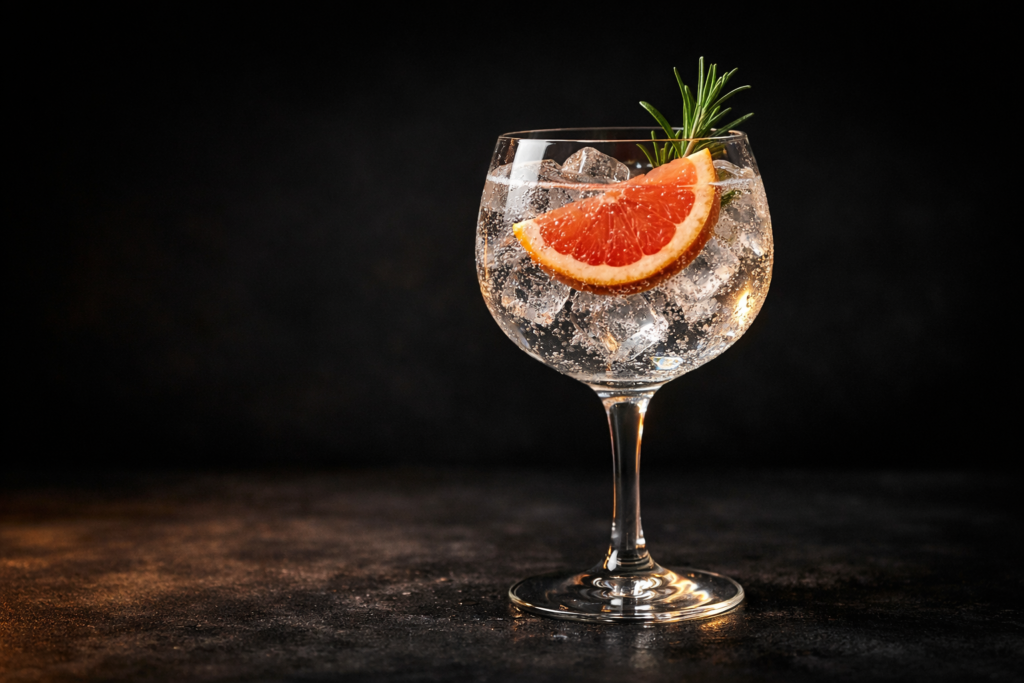
You bought a bottle of Monkey 47. Forty-seven botanicals, precisely crafted in the Black Forest, probably not cheap wherever you found it. You poured it over ice, topped it with tonic, and squeezed a lime wedge into the glass.
Congratulations, you just ruined your gin.
Not with the pour. Not with the tonic (though we’ll get to that). With the garnish. That lime wedge you didn’t think twice about just dumped a wall of citric acid into a gin built on layers of delicate florals, herbs, and spice. You buried every single one of them. Forty-seven botanicals and you’re tasting only lime.
As a flavour professional, this is the thing that keeps me up at night. Watching bars charge a premium for quality gin and then hand it over with a generic lime wedge that fights everything the distiller spent months putting into the bottle. It’s not a crime, but it should be.
Table of Contents
The Build
The Classic Gin & Tonic Recipe
Ingredients
- Gin
- Tonic water
- Ice
- Lime wedge
Glass: Highball.
Method
- Pour gin over ice.
- Add tonic.
- Garnish with lime.
- Serve.
That’s the recipe you’ll find everywhere. Four steps, a highball glass, and nothing to think about. You could teach it to someone who’s never made a drink and they’d get it right on the first try.
The recipe isn’t wrong. It’s just not good enough. Every step above has a decision hiding inside it that most people never think about. The glass. The pour order. The ice. The tonic. The garnish. Those decisions are the difference between a forgettable drink and one that makes someone ask what you just handed them.
So let’s take it apart.
The Glass
The recipe says highball. I say copa.
Big balloon glass, 620 ml or larger. The Spanish figured out the gin tonica years ago and the rest of the world is still catching up. The wide bowl gives your ice room to breathe, your garnish room to exist, and most importantly, it funnels every aromatic compound in the gin straight to your nose before the glass even touches your lips.
Pouring quality gin into a highball is like buying concert tickets and sitting in the car park. You’ll hear something. You’ll miss everything that matters. A rocks glass is even worse. That’s not even watching from the car park. That’s staying home.
The Pour
The recipe says pour gin over ice. Don’t.
Gin first. Before the ice. Into an empty glass. You need to see how much you’re pouring. Add ice first and the volume disappears between the cubes. You lose all reference for what’s actually in there.
I don’t measure. Years of making drinks will do that. You stop counting millilitres and start reading the glass. A navy strength gin gets a lighter pour than a standard 40%. A guest who doesn’t drink much gets less. Someone who appreciates a proper G&T gets a generous one. You read the gin, you read the room, you pour accordingly. You’re not a bar protecting margins, so pour intentionally.
If you’re still learning, start around 60 ml and adjust from there. Too strong? More tonic. Too weak? More gin. The G&T is forgiving at the pour in a way that a Negroni simply isn’t. You won’t ruin it with an extra 10 ml either way. The garnish is a different story.
One bottle of Fever-Tree per glass. No more, no less. Pour it slowly, down the side of the glass or against the ice. The carbonation is the texture of this drink. Kill it and you’ve got flat, bitter water with gin in it. One gentle fold after pouring. Do not stir a G&T like you’re dissolving something.
The Ice
The recipe doesn’t mention ice quantity. It should.
Fill the glass. Not three cubes rattling around at the bottom. The more ice, the colder the drink stays and the slower it dilutes. A half-filled glass warms up fast, the ice melts fast, and by sip four you’re drinking gin-flavoured water with a memory of carbonation.
Ice quality matters more here than in most drinks. A good chunk of your finished G&T is melted ice. If your ice tastes like your tap water, so will your drink. Filtered water or bought ice. Your gin deserves better than chlorine.
Choosing Your Gin
Most gin and tonic guides tell you to start with a London Dry. Tanqueray, Beefeater, Bombay Sapphire. Juniper-forward, clean, classic.
It’s not wrong. It’s just not very interesting.
London Dry makes a perfectly serviceable G&T. Juniper, tonic, done. But the botanical profile is so straightforward that there’s not much for a garnish to work with. You’ll squeeze a lemon in it because there’s nothing else to do with it. And that’s fine if “fine” is what you’re after.
It’s not what I’m after. If the most interesting thing about your gin is the juniper, the most interesting thing about your G&T will be the tonic.
Here’s what I actually pour:
Four Pillars Rare Dry is the everyday gin. Australian, orange-forward, enough backbone to stand up to tonic but enough complexity to reward a proper garnish. If I had to drink one gin in a G&T for the rest of my life, this would be it.
Hendrick’s is still a great gin. Cucumber and rose, unmistakable, and one of the few bottles where the botanical identity is so clear you already know what to do with it before you’ve poured the tonic.
Monkey 47 is for when you want to make someone stop mid-sip and ask what’s in their glass. Complex, impossibly layered, and a G&T that changes character entirely depending on what you pair it with. This is the gin that makes the garnish section of this guide necessary.
Tanqueray No. Ten is refined, citrus-forward, and versatile. Perfectly good on its own, but it comes alive with fresh fruit. That’s all I’ll say for now.
Gunpowder Irish Gin is oriental-spiced, bold, and distinctive. Citrus peel, gunpowder tea, and a slow burn that lingers. Gin Mare is Mediterranean herbs in a bottle, thyme-forward, with olive and rosemary running underneath. Nordés is the wild card: intensely floral, grape-based, and genuinely difficult to pair. If you can build a good G&T with Nordés, you can build one with anything.
And one rule that I will not bend on:
No barrel-aged gin in a G&T.
I’m obsessed with barrel-aged gins. They’re extraordinary in a Negroni. But they don’t belong here. The oaky, vanilla, caramelic notes that make a barrel-aged gin sing in a stirred cocktail have no business fighting carbonation and tonic water. The barrel softens a gin’s edges, which is beautiful when you’re sipping something slow and spirit-forward. In a long drink that needs sharpness, lift, and botanical clarity? I love barrel-aged gins more than most people love their pets. But they still don’t belong in a G&T.
The Tonic
The tonic is two thirds of your drink. It has three jobs: dilute the gin to a strength where you can actually taste the botanicals, provide bitterness from quinine that creates tension with the gin’s sweetness and aromatics, and carbonate, which lifts volatile compounds off the surface and gives the drink its texture. A good tonic does all three and gets out of the way.
Mass Market Tonics
Schweppes and its equivalents were built for a different era of gin. Gordon’s, Beefeater, Bombay. Juniper-forward, uncomplicated bottles that didn’t ask much of their mixer. If that’s still what you’re pouring, a mass market tonic will do the job. But if you’re reading this guide, you’ve probably moved on.
Read the ingredients on your local Schweppes bottle. Then read them again. Then put it back on the shelf.
Most now use artificial sweeteners or sweetener blends instead of sugar. The sweetness hits your palate differently than cane sugar. It arrives late, lingers too long, and leaves an aftertaste that sits on top of everything else in the glass. The gin’s finish gets buried under a synthetic tail that has no business being there. Add strong flavouring compounds and minimal quinine, and all you’re left tasting is the tonic, not the gin.
Premium Tonics
Fever-Tree, East Imperial, Fentimans, Double Dutch, Franklin & Sons. The premium market has exploded and they’re not all equal. What they share is a cleaner composition: real sugar, natural quinine, less aggressive flavouring. They let the gin breathe.
I use Fever-Tree exclusively. Clean, consistent, widely available, and it does its job without trying to be the star. The 200 ml bottle format is ideal: one drink, one bottle, no measuring, no leftover tonic going flat in your fridge.
Flavoured Tonics
Elderflower, rhubarb, yuzu, grapefruit, cucumber. The shelves are full of them.
Ignore all of it.
If you need your tonic to taste like elderflower to enjoy your G&T, the problem isn’t the tonic.
The tonic’s job is to support the gin, not compete with it. The moment your tonic starts adding its own signature flavour, it’s fighting the gin for attention. The flavour in a G&T should come from the garnish, not the mixer. That’s where personalisation lives.
Two tonic styles. That’s all you need.
Indian tonic is the default. Clean bitterness, balanced sweetness, works with the vast majority of gins. If you’re unsure, pour Indian.
Mediterranean tonic is softer, more floral, with herbal and citrus notes. For gins that lean citrus-forward or botanical, it complements without overshadowing. The gin keeps its personality.
Everything else is a spiked soda.
The Garnish
This is where it all comes together.
It’s not decoration. It’s not an afterthought. It’s not “whatever citrus is in the fridge.” The garnish is the single decision that has the most power to make or break your gin and tonic, and it’s the one that almost everyone gets wrong.
The Problem
Walk into most bars and order a G&T with a premium gin. Watch what happens. Nine times out of ten, you’ll get a lime wedge squeezed into the glass. Doesn’t matter if it’s a Hendrick’s, a Monkey 47, a Gin Mare. Lime. Every time.
The bartender didn’t think about it. The menu didn’t specify. And most people accept it because they’ve never tasted anything else. And the bars aren’t helping. Most of them treat the garnish station the way airlines treat legroom. Technically it exists, but nobody’s putting any thought into it.
The Principle
Smell your gin. Open the bottle, hold it under your nose, and pay attention. Or read the label. The botanicals are usually listed. What’s dominant? Citrus? Herbs? Florals? Spice? Cucumber? That’s your starting point.
If you can’t identify anything, pour a small amount neat, add a couple of drops of water, and try again. The water opens it up.
The garnish should extend or complement what’s already in the gin. Not fight it. Not replace it. Continue the conversation the distiller started. You’re not inventing a new flavour. You’re turning up the volume on one that’s already there.
By Gin Profile
Juniper-forward (London Dry): Lemon or lime. This is the one category where the classic garnish actually works. The acidity cuts through the juniper and the profile is robust enough to handle it. Tanqueray, Beefeater, Sipsmith. Squeeze, drop, done.
Citrus-forward: Grapefruit or orange. A slice and a gentle squeeze to brighten the drink and lift the citrus notes already there. Four Pillars is orange-forward: an orange slice, not a lime. Gunpowder loves grapefruit. Optional rosemary or thyme if the gin has herbal undertones.
Herbal and botanical: Rosemary, thyme, mint. Better paired with citrus than alone. Gin Mare with an orange slice and a sprig of rosemary: the rosemary amplifies the herbal notes, the orange adds warmth without competing. The Botanist with rosemary and grapefruit. These gins are built on complexity, and the garnish needs to meet them there.
Tropical: Lime squeeze first. The acidity opens up the gin and lifts the fruity notes. Then garnish with the fruit: a pineapple slice for Gunpowder Brazilian Pineapple or Tanqueray No. Ten. This is the category that leads most naturally into the elevated G&T.
Spice-forward: Orange slice as the standard. The sweetness rounds out the spice without dulling it. Baigur is a Saigon gin, heavy on cardamom with a warm, aromatic finish. You can echo the gin’s dominant spice with the garnish: a cardamom pod, a star anise. But careful. Spice garnishes overpower fast.
Other Garnishes
Cucumber: Hendrick’s and Martin Miller. Thin slices, not chunks. The cucumber adds freshness and a clean, green aroma that mirrors the gin’s character. Putting lime in a Hendrick’s is like putting ketchup on sushi. You can. But why would you.
Apple: Caorunn and Elephant Gin both have apple in their botanical profile. Apple slices, no acidity needed. Soft, clean, and lets the gin’s other notes come through.
Berries: Brockmans is heavily in the berry territory. Blackberries or blueberries in the glass, standalone or alongside grapefruit. On their own, the berries double down on what the gin is already doing: dark fruit, sweetness, depth. With grapefruit, you get contrast instead, the bittersweet citrus pulls the berry notes forward and adds brightness. Two different drinks from the same gin. Lawrenny, a Tasmanian gin with a delicate fruit-forward profile, pairs beautifully with strawberries.
Grapes: Nordés. The hard one. Green grapes work. Soft, neutral-sweet, and they give the florals something to land on without fighting them. If you can build a good garnish for Nordés, you understand the principle.
And Then There’s Monkey 47
My all-time favourite gin. Complex, subtly layered, and extraordinarily well balanced.
Grapefruit. Always. A half slice in the glass. The grapefruit’s bittersweet character plays with that complexity without trying to compete with it. That’s the standard.
This gin rewards experimentation. Try adding a couple of blueberries alongside the grapefruit. Or raspberries. Or a few pink peppercorns, lightly muddled. These are additions to the grapefruit, not replacements. Each one pulls out a different layer.
Quick Reference
| Garnish | Best With | Notes |
|---|---|---|
| Lemon or lime wedge | London Dry (Tanqueray, Beefeater, Sipsmith) | The only gins where default citrus works |
| Grapefruit slice | Citrus-forward (Gunpowder), herbal (The Botanist), Monkey 47 | The most versatile garnish after lime |
| Orange slice | Citrus-forward (Four Pillars), herbal (Gin Mare), spice-forward (Baigur) | Pairs with herbs for herbal gins |
| Herbs | Herbal and botanical gins (Gin Mare, The Botanist) | Better paired with citrus than alone |
| Cucumber slices | Hendrick’s, Martin Miller | Thin slices, not chunks |
| Pineapple | Tropical (Gunpowder Brazilian Pineapple, Tanqueray No. Ten) | Lime squeeze first to lift |
| Apple slices | Caorunn, Elephant Gin | No acidity needed |
| Berries | Brockmans, Lawrenny | Standalone or with grapefruit |
| Green grapes | Nordés | Soft, neutral, lets florals breathe |
The garnish is the last thing that goes into the glass and the first thing your nose encounters. Every other decision was building toward this moment. Don’t waste it on autopilot.
Elevating Your G&T
Everything up to this point has been about making a proper gin and tonic. The right glass, the right pour, a clean tonic, a garnish that matches the gin. That alone puts you ahead of most people.
This is about going one step further. Still a G&T. But with one added ingredient that transforms the drink into something worth talking about. This is also what I make for people who tell me they don’t like gin and tonics. The classic G&T is clean and sharp. These are fruitier, softer, and a different experience entirely.
The principle is the same as the garnish: work with the gin, not against it. But now instead of an aromatic garnish sitting on top, you’re introducing a flavour element into the drink itself. The fruit becomes an ingredient. The garnish shifts to a supporting role: herbs, spices, the extra touch that gives the drink its identity.
Passion Fruit
Half a passionfruit, scooped straight into the glass over the ice. The seeds add texture and visual impact. Top with tonic, garnish with lime, serve. The lime is essential: it balances the passionfruit’s sweetness and ties the acidity together.
Tanqueray No. Ten is the natural match. Citrus-forward and clean, the perfect canvas for tropical fruit.
If your guests don’t want the seeds, shake the passionfruit pulp briefly with the gin and strain into the glass before adding ice and tonic. Same flavour, cleaner drink. Both versions work. Read the room.
You can push this further: muddle pineapple in the shaker alongside the passionfruit and gin, then strain. The sweetness stacks, so the lime becomes even more important to keep balance.
Grapefruit
As a garnish, grapefruit is a half slice in the glass. For the elevated version, squeeze one to two slices into the drink before building. The juice integrates with the tonic, creating something brighter and more layered than a garnish alone could deliver.
Keep the half slice as your garnish, but the secondary garnish becomes the differentiator. Without it, the drink is monochrome grapefruit. With it, you’ve got depth.
Gunpowder with grapefruit and a rosemary sprig, or an orange half slice for a warmer, rounder profile. Monkey 47 with grapefruit and a couple of blueberries, raspberries, or pink peppercorns lightly muddled.
Yuzu
A touch of pure yuzu juice, added directly into the built drink. No shaking, no fuss. Yuzu has a citrus complexity that lime and lemon can’t match: floral, tart, slightly bitter, and immediately recognisable as something premium.
The garnish is essential here. The yuzu adds flavour, the garnish adds identity. Roku with yuzu and thin slices of ginger. Gin Mare with yuzu and a sprig of thyme or rosemary. The yuzu does the heavy lifting. The garnish tells you where you are.
The Pattern
You could keep going. That’s the point. Once you understand how the gin’s profile connects to the garnish, and how a single fresh ingredient can shift the whole drink, the combinations are endless.
Start with these three. They’re proven, they’re simple, and they’ll make you the person at the party who makes drinks people remember.
Troubleshooting
Most G&T problems can be fixed in the glass. Diagnose what’s off, adjust, move on.
The Build
Too strong. More tonic. The G&T is the only cocktail where this is genuinely that simple.
Too weak. More gin. And next time, pour like you mean it. A timid pour makes a timid drink.
Flat, no carbonation. You poured the tonic too aggressively or stirred too hard. The fizz is gone and it’s not coming back. This round is a loss. Next time, pour slowly down the side. One gentle fold. That’s all.
Warm. Not enough ice. Fill the glass next time. If it’s already warm, add more ice, but the drink has already started its decline. Drink faster.
The Garnish
Can’t taste the gin’s botanicals. Your garnish is fighting the gin, not complementing it. Lime on a floral gin. Lemon on a cucumber gin. The acidity is masking everything the distiller put in the bottle. This is the single most common mistake in every G&T made anywhere in the world. Smell the gin first. Match accordingly.
Smells like citrus cleaner. Too much lime or lemon juice. A gentle squeeze, not a full press. Citrus should brighten, not dominate. If it’s already overdone, a touch more tonic to dilute the acidity. Lesson learned.
Garnish doing nothing. Wrong match. A cucumber slice in a spice-forward gin adds nothing because there’s nothing for it to connect to. If you can’t smell the garnish when you lift the glass, it’s not working. Go back to the principle: what’s in the gin?
The Elevated G&T
Too sweet. The fruit has more sugar than you accounted for. Passion fruit and pineapple are the usual suspects. Lime squeeze to cut through it. Next time, less fruit or build the lime in from the start.
Too many flavours competing. One fruit. One garnish. One tonic. That’s the formula. If you added all three plus a herb and a spice, that’s not elevated. That’s a mess. Strip it back. Let each element breathe.
Fruit overpowered the gin. Too much fruit, or the gin wasn’t bold enough for the pairing. A delicate floral gin will vanish under passion fruit. Match the intensity of the fruit to the intensity of the gin. If in doubt, start with less. You can always add more.
Frequently Asked Questions
What is the best ratio for a gin and tonic? Around 1:3 (gin to tonic). 60 to 80 ml of gin with one 200 ml bottle of tonic. But the G&T is forgiving. Too strong? Add tonic. Too weak? Add gin.
What glass should I use for a gin and tonic? A copa or burgundy wine glass, 620 ml or larger. The wide bowl holds more ice, gives the garnish room, and funnels the gin’s aromatics to your nose.
Should I measure my gin for a G&T? If you’re starting out, 60 ml is a safe place to begin. As you get comfortable, you’ll stop measuring and start reading the glass. The G&T rewards feel more than precision. The garnish is where the precision matters.
What tonic water should I use? A premium tonic with natural quinine and real sugar. Avoid tonics with artificial sweeteners. Indian tonic is the default. Mediterranean tonic works well with citrus-forward and herbal gins. Avoid flavoured tonics entirely.
Why not flavoured tonic? The tonic’s job is to dilute, bitter, and carbonate. The moment it adds its own signature flavour, it’s competing with the gin. Personalisation comes from the garnish, not the mixer.
What garnish should I use for a gin and tonic? Smell your gin. Juniper-forward gins work with lemon or lime. Citrus-forward gins pair with grapefruit or orange. Herbal gins pair with rosemary or thyme alongside citrus. Cucumber for Hendrick’s. Match the garnish to the gin’s botanical profile.
Can I use lime with any gin? Lime works with London Dry gins. For most modern and craft gins, lime overpowers the botanicals. Match the garnish to the gin’s profile instead.
What is an elevated G&T? A gin and tonic with one added fresh ingredient (passion fruit, grapefruit juice, yuzu) that transforms the drink without turning it into a cocktail. The fruit becomes part of the mix, and the garnish shifts to a secondary role.
Is Schweppes tonic bad? Read the label. Most Schweppes varieties now use artificial sweeteners instead of sugar. With a London Dry, you might not notice. With anything more complex, you will.
Should I put barrel-aged gin in a G&T? No. Barrel-aged gins are extraordinary in a Negroni, but the oaky, vanilla notes fight carbonation and tonic. Save them for stirred cocktails.
Three ingredients. One decision that matters more than the other two. Now go make something worth drinking.